How Connecting State Actors Helps Learners Succeed: The Example of Fair Chance to Advance
The importance of states in expanding postsecondary education in prison has never been more evident. State departments of corrections, postsecondary education systems, and workforce agencies hold the keys to access, funding, and alignment of services for incarcerated learners. In recent years, Ascendium has supported collaborations within individual states — such as Georgia, New York, and Minnesota — to strengthen these systems and expand opportunity.
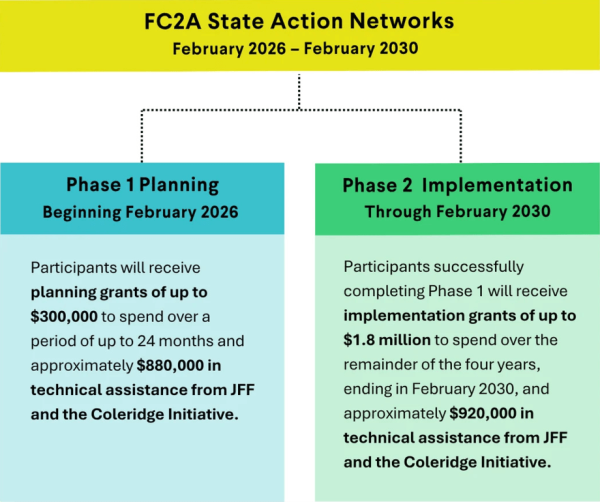
Now, with support from Ascendium, Jobs for the Future (JFF) has launched the Fair Chance to Advance initiative to take this work a step further. This effort connects leaders across systems within a number of states to form coordinated action networks. By sharing data, aligning policies, and empowering policymakers across states to “Normalize Opportunity,” these networks have the potential to transform education and employment pathways for justice-impacted learners on an unprecedented scale.
From Incarceration to Graduation and Beyond
Nearly one in three Americans has a record of arrest, conviction, or incarceration (Source: National Conference of State Legislatures). Too often, people leave prison ready to work but find that the systems meant to support them are disconnected and difficult to navigate. Fair Chance to Advance aims to help states build stronger connections between education, workforce, and reentry efforts so more people with histories of incarceration can build new futures.
With the 2023 reintroduction of Pell Grants for incarcerated learners, the potential for meaningful change is within reach. But access to federal financial aid is only one part of the solution. A degree alone does not remove the added barriers justice-impacted learners face upon reentry.
Finding a job is the bare minimum; what matters is access to a career path that offers economic advancement and long-term stability. This is key to helping justice-impacted learners remain out of prison and thrive in their communities.